Salary account overdraft
A limit offered on the account where your salary is credited, based on your salary and profile.

Last updated:
Understand how a salary-linked overdraft works, how it differs from a personal loan, and submit an enquiry to discuss your requirement.
Enquire about Salary Overdraft
Thanks for sharing your details. Our team will review your requirement and connect with you shortly.
A salary overdraft is a revolving credit limit for salaried people, usually linked to the bank account where your salary is credited. You can withdraw more than your balance, up to the approved limit, and your salary credit and other deposits reduce what you owe.
Unlike a personal loan, there is no lump sum and no fixed EMI schedule. Interest is generally charged only on the amount you use, for the days you use it. The limit, rate, charges and how you must repay are set by the lender, so read the terms before you start using it.
Lenders base the limit mainly on your salary and repayment record. Criteria differ by lender; commonly reviewed factors are:
If you already have a salary account with the lender, it may need very little from you. Otherwise, the usual list is below; lenders may ask for more.
A salary overdraft is set up as a limit on your account rather than paid out as a loan. The usual sequence is:
You apply with your bank or lender, often through its app or branch, with basic personal, employment and salary details.
The lender verifies your identity and income. Existing salary-account customers may need fewer documents.
The lender checks your credit report and existing EMIs to decide whether to offer a limit, and how much.
If approved, you receive the limit, interest rate, validity, renewal terms and charges in writing. Check how interest is calculated and how you must repay.
After you accept the terms, the limit is set up on your account and you can draw from it when needed.
Your salary and other deposits reduce the balance. The lender reviews the facility periodically and may renew, change or close it as per the agreement.
Enter the amount you expect to use, the interest rate from your offer and how many days it will stay unpaid to see the interest for that period.
Example only, not an offer
Simple daily interest on the amount used. It excludes fees, renewal charges and taxes. Open the full EMI calculator
A personal loan gives you the full amount at once, and you repay it in fixed EMIs over an agreed tenure, with interest on the outstanding loan balance. A salary overdraft gives you a limit, and you pay interest only on what you draw, for as long as it stays unpaid.
That makes an overdraft useful for short gaps that your next salary will cover, such as a medical bill or an urgent payment near the end of the month. For a one-time expense you will repay over many months, a personal loan's fixed EMIs are often easier to plan.
Under RBI directions, for facilities sanctioned or renewed on or after 1 January 2026, regulated lenders cannot levy prepayment charges on an overdraft if you tell them, within the period stated in your agreement, that you do not want it renewed, and it is closed on the due date.
Source: RBI (Pre-payment Charges on Loans) Directions, 2 July 2025.
Salaried people can get an overdraft in a few different ways. What is available, and on what terms, depends on the lender.
A limit offered on the account where your salary is credited, based on your salary and profile.
A limit from a bank or NBFC, often through an app, which you draw into your bank account as needed and repay with interest on the amount used.
A limit secured by your fixed deposit with the lender. Your deposit stays invested while you use the limit.
A limit secured by shares, mutual funds, insurance policies or other securities the lender accepts.
Overdraft offers differ in more than the rate. When you compare:
An overdraft can carry fees even when you draw little. Charges differ by lender, so check each of these in writing:
Charged when the limit is set up.
Charged when the facility is reviewed and renewed.
How it is calculated, and how often it is debited.
If you exceed the limit or miss a required payment.
Tax added to the processing fee and other charges.
Any annual or maintenance fee. Ask the lender to explain anything you do not understand.
| Salary overdraft | Personal loan | Credit card | |
|---|---|---|---|
| How funds are given | A limit you draw into your account when needed | A one-time lump sum | A revolving limit for purchases and payments |
| How interest is charged | Generally only on the amount used, for the days it is used | On the outstanding loan balance, built into fixed EMIs | Usually none on purchases if the full bill is paid by the due date; charged on unpaid balances, per card terms |
| Cash access | Withdraw or transfer from the account | Paid into your bank account | Cash withdrawals usually carry fees and interest from the day of withdrawal |
| Repayment | Flexible; deposits reduce the balance, per lender terms | Fixed EMIs over an agreed tenure | Monthly bill; paying only the minimum due leaves interest on the rest |
| Best for | Short gaps covered by your next salary | A one-time expense repaid over months | Everyday spending repaid within the billing cycle |
Swipe the table sideways to see all three options.
Rates, limits and charges differ by lender and by your profile, so compare actual offers rather than product types alone.
Lenders do not always share the exact reason. Common ones include:
Before you reapply, check your credit report and correct any errors, pay down existing dues, and ask your salary-account bank, which already sees your salary credits, about the options it offers.
An overdraft is easy to dip into, which also makes it easy to overuse. Protect yourself:
Borrow only from RBI-regulated banks and NBFCs. If you are unsure about a lender, check that it is a bank or an NBFC registered with the RBI.
Check that the lender's name on the sanction letter and agreement matches the lender you applied to, including when you apply through an app or an agent.
Never pay an upfront fee to "get a loan approved". Genuine fees are disclosed in writing by the lender.
Do not share OTPs, PINs, passwords or card details with anyone who calls or messages you about a loan.
Read the loan agreement fully before you sign, and keep a copy of every document you sign.
Use the overdraft for short gaps and bring it back down with your salary. A balance that never falls costs more than a personal loan.
A personal loan is paid out once and repaid in fixed EMIs. A salary overdraft is a limit on your account that you can draw from when needed, with interest generally charged only on the amount used, for the days it stays unpaid.
Generally no. Interest is usually charged only on the amount you use, for the days it stays unpaid, though some lenders charge processing or renewal fees on the limit. Check the terms before you accept.
The limit depends on your salary, credit history, existing EMIs and the lender's policy. The lender confirms the limit when it approves the facility.
Many salary overdrafts are offered on the account where your salary is credited. Some banks and NBFCs offer personal credit lines without a salary account with them. It depends on the lender.
Deposits into the account, including your salary, reduce the balance. Some lenders also require interest or a minimum amount each month, or the balance to be cleared by a set date. Check the repayment terms in your agreement.
Yes. Once you repay what you drew, that amount is usually available again within the approved limit, as long as the facility is valid and in good standing.
It depends on how you need the money and how quickly you can repay. Cash withdrawals on a credit card usually carry fees and interest from the day of withdrawal, while an overdraft charges interest on the amount used. Compare the actual charges on both.
Yes. An overdraft is a credit facility, so lenders report it to credit bureaus. Staying within the limit and meeting repayment terms helps; going over the limit or missing payments can lower your score.
Yes, after clearing the balance. For facilities sanctioned or renewed on or after 1 January 2026, regulated lenders cannot levy prepayment charges if you inform them within the period stated in your agreement that you do not want the facility renewed, and it is closed on the due date.
Common reasons include a low credit score, irregular salary credits, a high existing EMI burden, a recent job change, or several recent credit applications.
29 Oct 2026
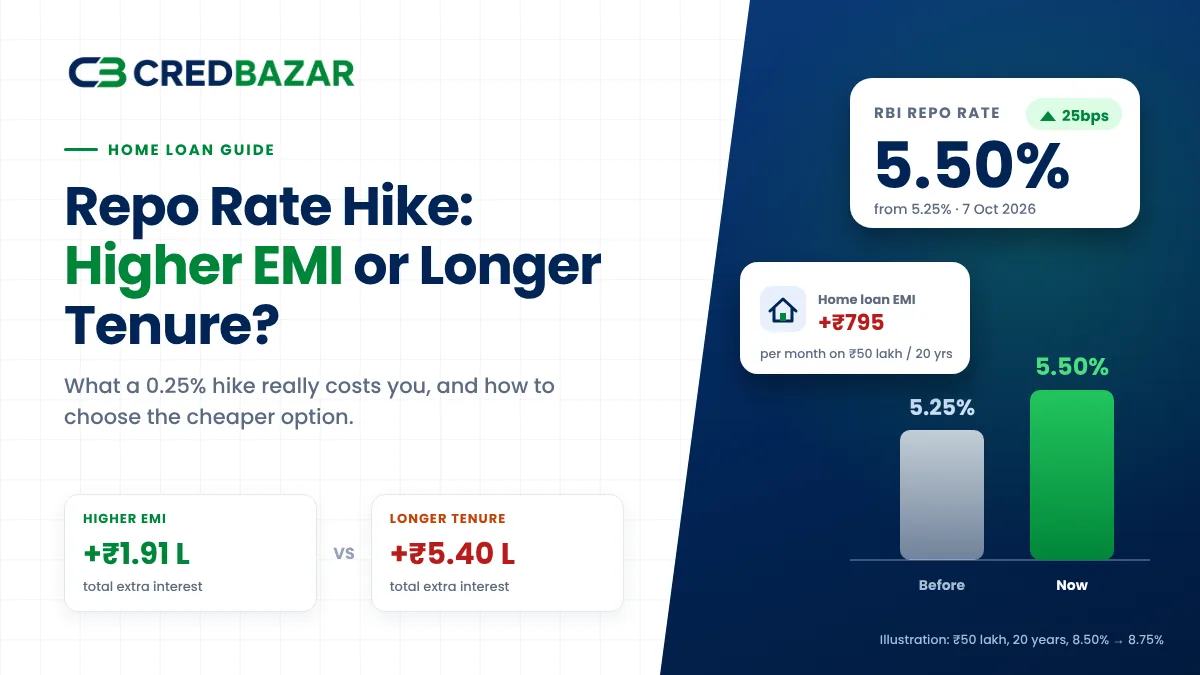
RBI has raised the repo rate to 5.50%. See how the hike affects your home loan or LAP, what a higher EMI or a...
29 Oct 2026
Earning well but still getting rejected? You are not alone. From the "Settled" CIBIL nightmare to negative pin...
09 Oct 2026
Thinking of taking a payday loan to survive until your next salary? Before you download that instant loan app,...
Fill in the short form on this page with your basic details and loan requirement.
The CredBazar team gets in touch to understand your requirement and explain the next steps.
Share the documents the lender asks for. Approval and final terms are decided by the lender.
About CredBazar. CredBazar helps you connect with lenders for your loan requirement. CredBazar is not the lender: whether your loan is approved, and the interest rate and terms you are offered, are decided by the lender.
The information on this page is general guidance and is not an offer of credit. Loan approval, interest rates, fees, tenure and other terms are decided by the lender and depend on your profile. Please read the lender's terms before you proceed.
Submit a short enquiry and the CredBazar team will get in touch with you.