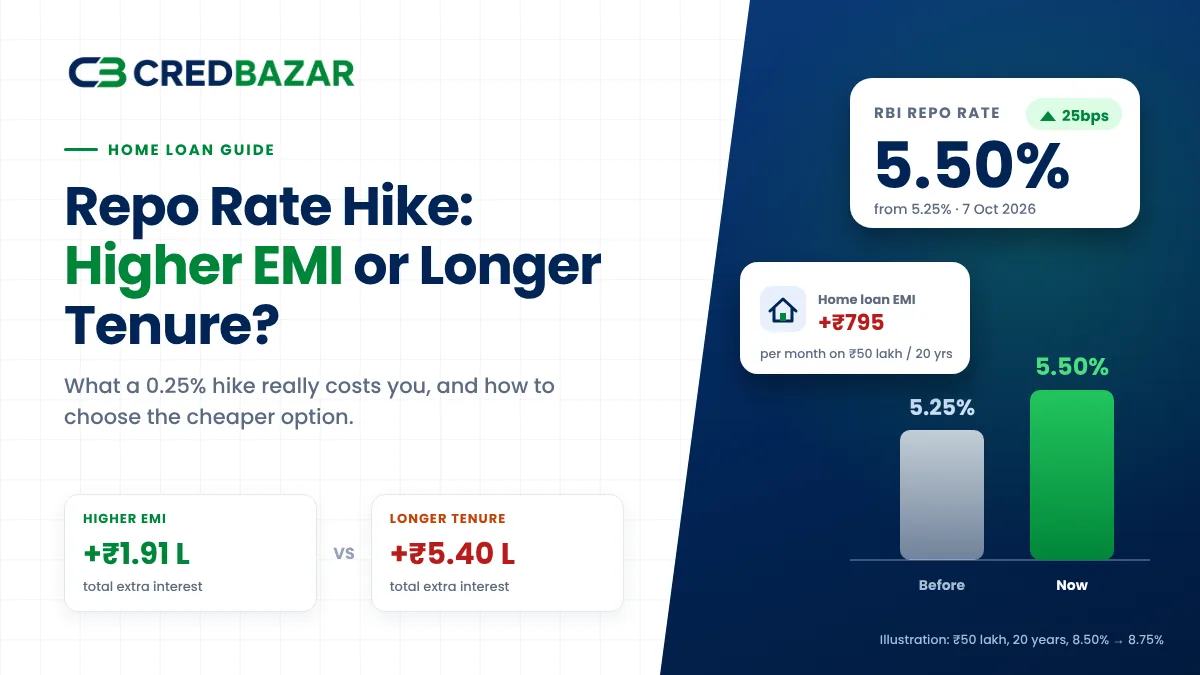
On 7 October 2026, the Reserve Bank of India's Monetary Policy Committee raised the policy repo rate by 25 basis points to 5.50% (RBI monetary policy resolution, 7 October 2026). If you have a floating-rate home loan or loan against property, this RBI repo rate hike may increase your interest rate at your next reset. Whether it does, when, and by how much depends on your loan's benchmark, your reset date and your lender's terms.
If your rate does go up, you will usually face one question: pay a higher EMI, or let the loan run longer? This guide explains which loans can be affected, compares the cost of each option with worked examples, and lists what to check with your lender.
RBI repo rate hike 2026: what it means for your loan
The repo rate is the rate at which the RBI lends short-term money to banks. When it rises, banks' borrowing costs rise, and loans linked to it can become more expensive.
Since 1 October 2019, banks have had to link all new floating-rate personal and retail loans, including home loans, to an external benchmark such as the repo rate, and reset the rate at least once every three months (RBI circular on external benchmark based lending, 4 September 2019). This rule applies to banks. Housing finance companies and NBFCs set their own benchmark rates, so their loans may change at a different time or by a different amount.
When a floating rate goes up, the increase normally shows up in one of two ways:
- A higher EMI, with the loan ending on the original date, or
- The same EMI with a longer tenure, so the loan ends later.
Which one happens depends on your loan agreement and your lender's policy. If your EMI has not changed after a rate increase, check whether your remaining tenure has gone up instead.
Which loans can be affected
Loans that may change
- Floating-rate home loans from banks linked to the repo rate (often called RLLR or EBLR loans). The rate on these loans is usually the repo rate plus a spread, so under the loan terms the repo part is updated on the next reset date, not on the day of the RBI announcement. Your sanction letter states the reset schedule.
- Floating-rate loans against property, if they are linked to the repo rate or another benchmark that moves with it.
- Older MCLR-linked loans. MCLR does not move one-for-one with the repo rate. Each bank calculates it from its own marginal cost of funds, the cost of holding cash reserves, its operating costs and a tenor premium, and reviews it monthly. A repo hike may raise MCLR by less, by more, later, or not at all. Your loan rate then changes only on its own reset date, and RBI rules require that reset period to be one year or shorter (RBI Master Direction on interest rate on advances).
- Floating-rate loans from HFCs and NBFCs, which follow the lender's own benchmark rate.
Loans that usually do not change
- Fixed-rate loans, including fixed-rate personal loans, car loans and home loans, until any fixed period ends. Check the rate type in your sanction letter or Key Fact Statement (KFS).
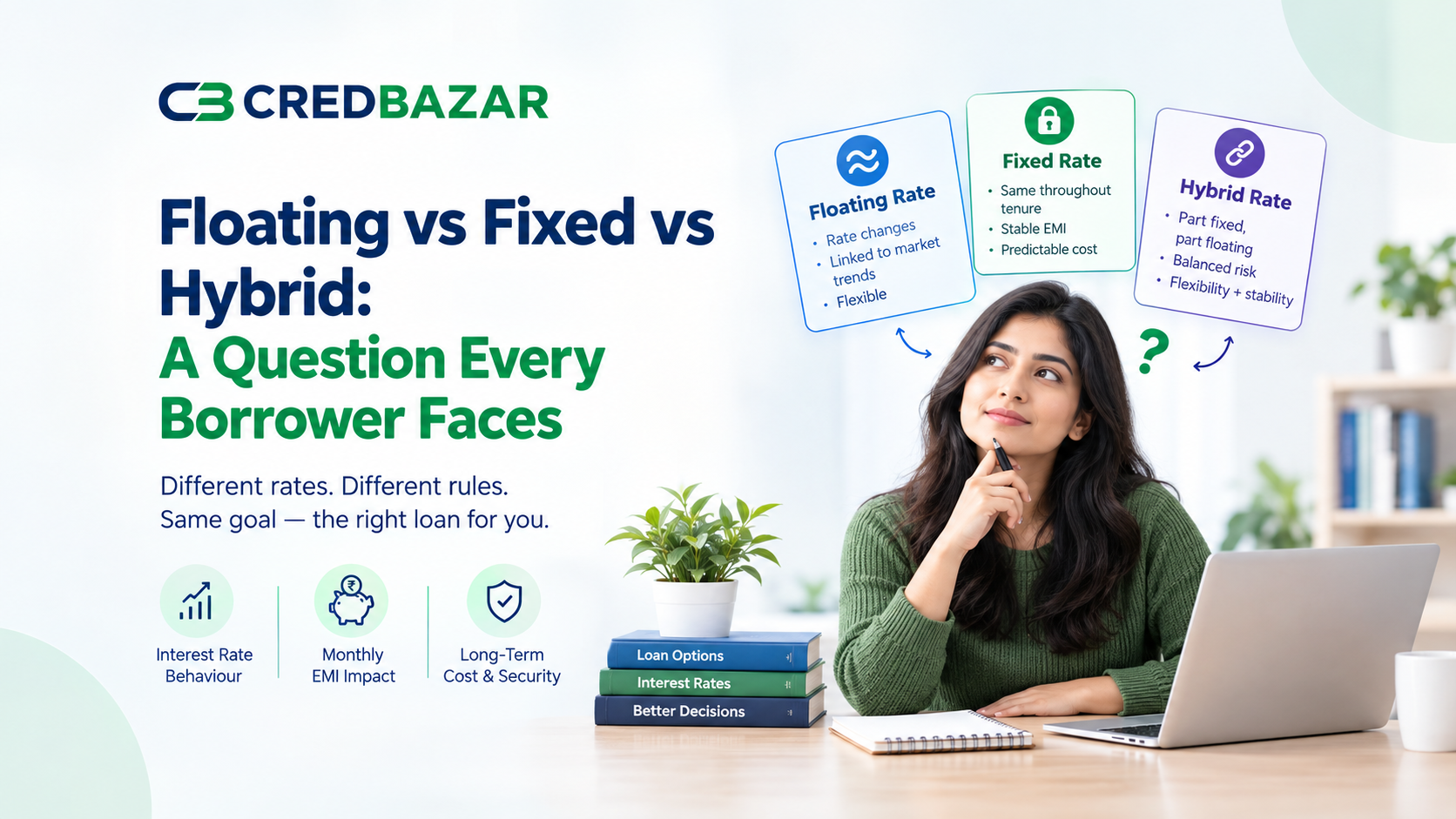
Not sure which type you have? Our guide to floating vs fixed vs hybrid interest rates explains the differences.
EMI vs loan tenure: what a 0.25% increase costs
How these examples work: they are illustrations, not offers or quotes from any lender. Each example assumes:
- the outstanding principal and remaining tenure shown,
- the loan rate rises by the full 0.25% from the next EMI, as it would for a repo-linked loan at its reset, and then stays the same (an MCLR-linked or NBFC/HFC loan may rise by a different amount), and
- a standard reducing-balance EMI, calculated monthly.
Your own figures will differ, so enter your outstanding amount, rate and remaining tenure in the CredBazar EMI calculator.
Example 1: home loan, ₹50 lakh outstanding, 20 years remaining
| Option | Rate | Monthly EMI | Repayment period | Total interest from now |
|---|---|---|---|---|
| No rate change | 8.50% | ₹43,391 | 240 EMIs | ₹54.14 lakh |
| Higher EMI | 8.75% | ₹44,186 (+₹795) | 240 EMIs | ₹56.05 lakh (+₹1.91 lakh) |
| Longer tenure | 8.75% | ₹43,391 (no change) | 253 payments: 252 full EMIs + a final payment of about ₹19,000 (13 more than 240) | ₹59.54 lakh (+₹5.40 lakh) |
In this example, paying ₹795 more each month adds about ₹1.91 lakh in interest. Keeping the EMI unchanged adds 13 payments (12 full EMIs and a smaller final one) and about ₹5.40 lakh in interest, nearly three times as much.
Example 2: loan against property, ₹30 lakh outstanding, 15 years remaining
| Option | Rate | Monthly EMI | Repayment period | Total interest from now |
|---|---|---|---|---|
| No rate change | 9.50% | ₹31,327 | 180 EMIs | ₹26.39 lakh |
| Higher EMI | 9.75% | ₹31,781 (+₹454) | 180 EMIs | ₹27.21 lakh (+₹0.82 lakh) |
| Longer tenure | 9.75% | ₹31,327 (no change) | 187 payments: 186 full EMIs + a final payment of about ₹1,200 (7 more than 180) | ₹28.28 lakh (+₹1.89 lakh) |
Here, paying ₹454 more each month adds about ₹0.82 lakh in interest. Keeping the EMI unchanged adds 7 payments (6 full EMIs and a small final one) and about ₹1.89 lakh in interest, more than twice as much.
Higher EMI or longer tenure: how to decide
A higher EMI may suit you if
- The extra amount fits comfortably in your monthly budget.
- You can still keep an emergency fund after paying it.
- You want the loan to end on its original date, for example before you retire.
A longer tenure may suit you if
- Your budget is already tight and a higher EMI could lead to a missed payment.
- The new end date is still comfortably before your retirement.
- You plan to make part-prepayments later, for example from a bonus.
A missed or late EMI is reported to credit bureaus and can lower your credit score, so affordability should come first.
Paying a little extra each month
If you can pay more than the new EMI, the saving can be large. In Example 1, paying ₹2,000 more than the new EMI (₹46,186 a month) would repay the loan in 215 payments instead of 240 and reduce total interest from about ₹56.05 lakh to about ₹49.03 lakh. Ask your lender whether you can raise your EMI voluntarily, or make regular part-prepayments instead.
Other ways to reduce the impact
1. Make a part-prepayment
RBI rules do not allow lenders to charge pre-payment penalties on floating-rate loans taken by individuals for non-business purposes. The current rules, the RBI (Pre-payment Charges on Loans) Directions, 2025, apply to loans sanctioned or renewed on or after 1 January 2026; loans taken earlier are covered by earlier RBI instructions. Fixed-rate loans may carry charges under your lender's policy, so check your KFS or loan agreement. When you prepay, ask whether the lender will reduce your tenure or your EMI. Reducing the tenure usually saves more interest.
2. Compare a balance transfer
If another lender offers a meaningfully lower rate, moving your loan may save more than the hike costs. Before switching, add up the processing fee, legal and valuation charges, and any other costs, and compare them with the interest you would save over your remaining tenure.
3. Ask whether you can switch to a fixed rate
Some lenders let floating-rate borrowers switch to a fixed rate, usually for a fee. For EMI-based floating-rate personal loans, RBI rules allow lenders to offer this switch at the time of reset under a Board-approved policy, but since an amendment in October 2025 lenders are not required to offer it. Fixed rates are often higher than current floating rates, so compare the total cost before you switch.
4. Ask about a lower spread
A repo-linked loan rate is usually the repo rate plus a spread set by the lender. If your credit profile has improved since you took the loan, ask whether you can move to a lower spread and what fee, if any, applies.
RBI rules on rate resets for EMI-based personal loans
RBI's framework on resetting floating interest rates applies to EMI-based floating-rate personal loans. According to RBI's FAQs on this framework, it does not apply to other types of loans, so home loans generally fall outside it (there is a limited exception for housing loans from urban co-operative banks). For an EMI-based floating-rate personal loan, lenders must:
- explain at sanction how a change in the benchmark rate may affect your EMI, tenure or both, and tell you promptly about any increase;
- let you choose a higher EMI, a longer tenure, or a combination of both;
- let you prepay in part or in full at any time during the tenure;
- not extend the tenure in a way that leads to negative amortisation, where the EMI does not cover the interest; and
- send a quarterly statement showing the principal and interest recovered so far, the EMI amount, the number of EMIs left, and the annualised interest rate.
Source: RBI circular on reset of floating interest rate on EMI-based personal loans and RBI FAQs on the same circular.
If you have a home loan, check your sanction letter and loan agreement for how rate changes are handled, and ask your lender directly.
Questions to ask your lender now
- Is my loan linked to the repo rate, MCLR or the lender's own benchmark rate?
- When is my next reset date, and from which EMI will the new rate apply?
- What will my new rate be, and what is my spread?
- Will you change my EMI or my tenure, and can I choose?
- How many EMIs will remain after the change?
- Can I switch to a fixed rate, and what would it cost?
- Are there any charges for part-prepayment on my loan?
Sample request to keep your original loan end date
You can adapt this message and send it through your lender's app, email or branch:
Dear Sir/Madam,
With reference to my loan account number [XXXX], I understand that the interest rate on my loan may change following the recent repo rate revision. If the rate increases, I request that my EMI be revised so that my original loan end date stays the same, instead of extending the tenure. Please confirm the revised EMI and share an updated repayment schedule.
Regards,
[Your name], [Registered mobile number]
Taking a new loan after the rate hike
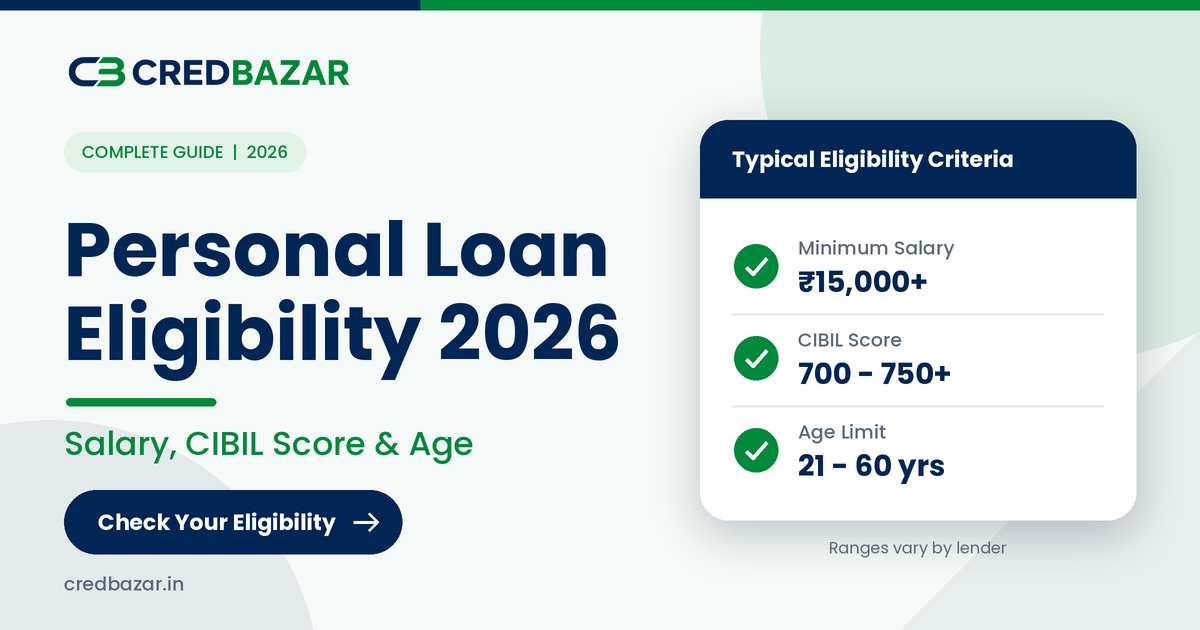
If you are applying for a new loan, compare the full cost, not just the headline rate: processing fees, other charges and how the rate is calculated all matter. Our guide to flat vs reducing interest rates explains why two loans with similar rates can cost very different amounts. If you are considering a personal loan, check personal loan eligibility by salary, CIBIL and age first.
Frequently asked questions
Will my EMI increase after the RBI repo rate hike?
Not automatically. It depends on your loan's benchmark and reset terms. A repo-linked bank loan is usually updated at its next reset; an MCLR-linked loan changes only if the bank's MCLR changes and your reset date arrives; NBFC and HFC loans follow the lender's own benchmark. Even when your rate goes up, your lender may extend your tenure instead of raising your EMI. Fixed-rate loans do not change until any fixed period ends.
When will the new rate apply to my loan?
It depends on your benchmark and reset date. Repo-linked loans from banks must be reset at least once every three months. MCLR-linked loans reset on the date in your loan agreement, at least once a year, and only reflect whatever change the bank has made to its MCLR. Loans from HFCs and NBFCs follow the reset terms in your loan agreement.
My EMI has not changed. Has my tenure been extended?
Possibly. Check your latest loan statement or ask your lender how many EMIs are left. If the number has gone up, your tenure has been extended.
Can I prepay my home loan without charges?
RBI rules do not allow pre-payment penalties on floating-rate loans taken by individuals for non-business purposes. Fixed-rate loans may carry charges, so check your loan agreement or KFS.
Does a repo rate hike affect my CIBIL score?
The rate change itself does not affect your credit score. Late or missed payments do, so make sure any higher EMI is affordable.
The bottom line
A 0.25% increase sounds small, but if it is absorbed by extending your tenure, the extra interest can run into lakhs over a long loan. Find out how your lender is applying the change, choose a higher EMI if you can comfortably afford it, and consider part-prepayments to bring the loan back on track. Check your own numbers with the CredBazar EMI calculator, or compare home loan and loan against property options if you are considering a balance transfer.
Sources
- RBI: Monetary Policy Statement 2026-27, Resolution of the MPC, 5 to 7 October 2026
- RBI: External benchmark based lending, circular dated 4 September 2019
- RBI: Reset of floating interest rate on EMI-based personal loans, circular dated 18 August 2023 (as updated)
- RBI: FAQs on reset of floating interest rate on EMI-based personal loans
- RBI: Pre-payment Charges on Loans Directions, 2025 (issued 2 July 2025)
- RBI: Master Direction on interest rate on advances (MCLR calculation and reset periods)
Written by the CredBazar team. Read more about CredBazar. How we prepared this article: the repo rate and regulatory points are taken from the RBI documents listed above. EMI and interest figures were calculated by CredBazar using the standard reducing-balance method and the assumptions stated with each example. This article is for general information only and is not financial advice. Interest rates, charges and policies vary by lender; check your loan agreement and confirm details with your lender before deciding.