Payday Loans in India: A Lifesaver or a Debt Trap? The Honest Truth
It’s the 25th of the month. Your bank account is showing a balance that makes you want to cry. The rent is due in two days, and your credit card bill just generated. Your salary is still a week away.
You get a text message: “Need cash before payday? Get ₹20,000 instantly. No paperwork. Zero tension.”
It sounds like a dream, right? That is exactly what a Payday Loan promises. But as a Senior Financial Consultant at CredBazar, I have seen this dream turn into a nightmare for hundreds of salaried Indians.
Today, let’s talk about payday loans in India. What are they, who qualifies, and the honest truth about whether you should actually take one.
What Exactly is a Payday Loan?
Let's cut the jargon. A payday loan is a very small, short-term, unsecured loan designed to cover your expenses until your next salary hits your account.
Unlike a traditional personal loan that might take 2-3 days to process, these are instant. You usually get the money in your account within minutes. You don't need to give any collateral like gold or property. The bank or NBFC (Non-Banking Financial Company) trusts you based on your salary.
When your next payday arrives, they simply auto-debit the money from your bank account using a NACH mandate (National Automated Clearing House).
According to the basic eligibility criteria, this sounds pretty standard. But here is where the "tension-free" promise starts to crack.
Who is Eligible? The Minimum Wage Reality
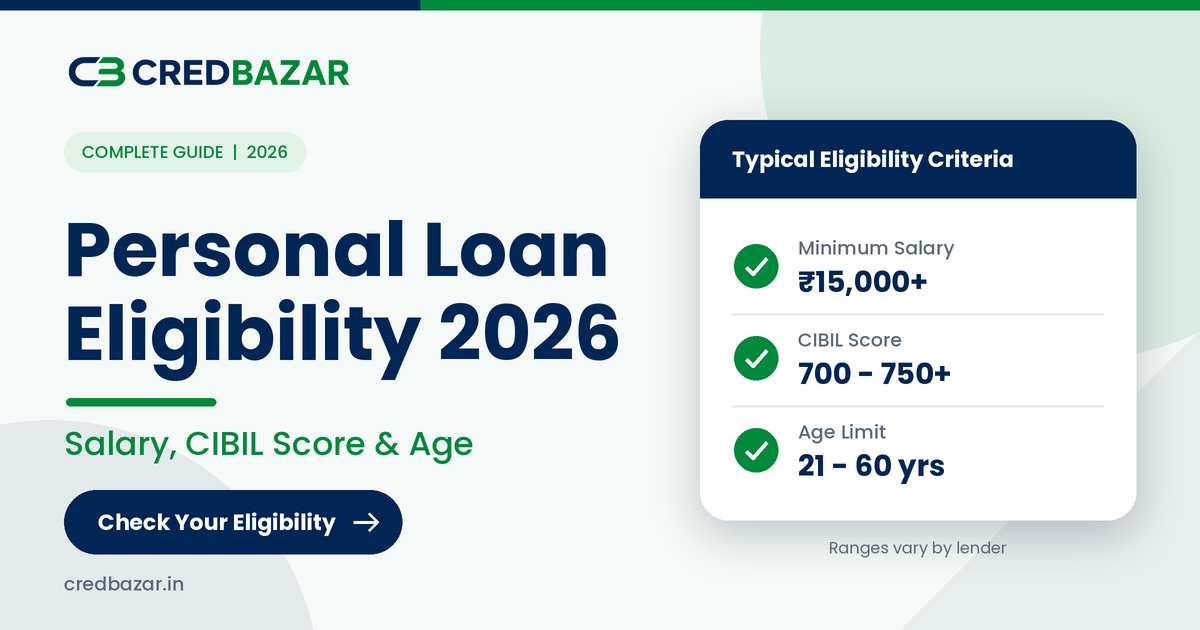
Let’s look at the eligibility criteria for these loans. Based on the standard industry norms and the guidelines shared by major lenders:
Citizenship: You must be a resident citizen of India.
Age: You need to be above 21 years old.
Employment: You must have a full-time job with a fixed income. Freelancers and gig workers usually get rejected here.
Salary: Here is the shocker. The minimum net monthly salary required is often just ₹10,000 or slightly higher, depending on the lender.
CredBazar Tip: If a lender is offering a loan to someone earning just ₹10,000 a month, they are taking a massive risk. And how do lenders cover massive risks? By charging massive interest rates.
The Paperwork is Actually Minimal
The only documents you usually need are:
Aadhaar Card (for identity and address)
PAN Card (for identity)
Voter ID or Driving License (to determine age and address)
Salary slips (last 3 months, to prove you are employed)
Because the paperwork is minimal, approval is quick. But speed often comes at a cost.
The Hidden Math: Why RBI is Watching
This is where I need you to pay close attention. Payday loans often come with high interest rates and fees.
Let’s say you borrow ₹10,000 for 15 days. The lender might charge you a fee of ₹1,000. It sounds manageable, right? "I'll just pay back 11,000 when my salary comes."
But let's do the real math. ₹1,000 on ₹10,000 for 15 days is roughly a 10% fee. If you annualize that (multiply it for the whole year), the interest rate is over 200%!
Compare that to a standard personal loan in India, which charges anywhere between 11% to 18% annually. Even a credit card, which has high interest, usually caps out around 36% to 42% annually.
Payday loans are designed to be convenient, but they are also designed to be incredibly expensive. The RBI has been cracking down heavily on digital lending apps because many of them were charging hidden processing fees, using shady recovery agents, and trapping people in a debt cycle.
The Auto-Debit Trap (NACH Mandate)
When you take a payday loan, you give the lender a NACH mandate. This means on your payday, the lender automatically pulls the money from your account.
Here is the problem: What if your salary is delayed? Or what if you had an emergency and the money isn't there?
If the auto-debit bounces, you get hit with penalty charges from your bank. Then, the lender adds their own late payment fees. Before you know it, a ₹10,000 loan has ballooned to ₹15,000.
CredBazar Tip: Never share your net banking credentials or give a blank NACH mandate to a random app. Always check if the lender is registered with the RBI. If they are not on the RBI's approved list, close the app immediately.
Payday Loan vs. Credit Card vs. Personal Loan
So, what should you do if you have an emergency and no cash? Let's compare your options.
1. Credit Card
If you have a credit card, you have an interest-free period of about 45 days. If you swipe your card for a medical emergency today, and your bill generates next week, you still have another 20-30 days to pay it off without paying a single rupee in interest.
Verdict: Much better than a payday loan, provided you pay the full bill on time.
2. Personal Loan
If you need money for a few months, a personal loan is the way to go. You can get up to ₹50 Lakhs, and you pay it back in easy EMIs over 1 to 5 years. The interest rate is fixed and regulated.
Verdict: The safest option for large or long-term emergencies.
3. Payday Loan
You need the money today, and you are 100% sure you can pay it back in 15 days.
Verdict: Extremely risky. Only for absolute dire straits.
The "Debt Trap" Reality
Why do I sound so negative about payday loans? Because I have seen the cycle.
A person takes a payday loan because they are short on cash. Payday comes, and the auto-debit clears their entire salary. Now they have no money for the rest of the month. So what do they do? They take another payday loan to survive the month.
This is called the debt trap. You are essentially renting money at a premium, and your entire salary goes towards servicing old debts.
If you are facing a job loss or a salary delay, a payday loan will not save you. It will bury you.
When Should You Actually Consider a Payday Loan?
There is only one scenario where a payday loan makes sense: You have a guaranteed salary coming in 3 to 7 days, you have a sudden, unavoidable expense (like a medical bill), and you have absolutely no other source of funds.
Even then, you must ensure that the total repayment amount (principal + fees) is less than 10% of your upcoming salary. If the repayment is going to eat up more than 10% of your paycheck, you cannot afford it.
CredBazar Tip: Before you click "Apply" on any instant loan app, ask yourself: "If I lose my job tomorrow, how will I pay this back?" If you don't have a solid answer, do not take the loan.
The CredBazar Verdict
If you are looking at a payday loan to cover your monthly expenses, you don't have a loan problem; you have a budgeting problem.
Instead of paying 200% interest to a predatory app, talk to a financial advisor. Look at your expenses. Can you cut down on subscriptions? Can you negotiate with your landlord?
If you truly need a loan for an emergency, go to a proper bank or an RBI-registered NBFC. At CredBazar, we work with top banks and NBFCs across India. We can help you get a personal loan at normal interest rates, with flexible EMIs that won't eat up your entire salary.
Don't let a short-term cash crunch ruin your long-term CIBIL score and mental peace.
Still confused about what to do? Don't just download any random app. WhatsApp CredBazar. Tell us your situation. We will give you honest advice—no spam, no pressure. We'll help you find the right loan, or tell you honestly if you should just wait for your salary.
Stay smart, stay tension-free.