Pre-approved personal loan
An offer a lender makes to an existing customer based on the information it already holds. It is an offer, not a guarantee; the lender still runs its checks before approval.

Last updated:
Find out how a personal loan works, what lenders usually look at, and submit an enquiry to discuss your requirement with our team.
Enquire about Personal Loan
Thanks for sharing your details. Our team will review your requirement and connect with you shortly.
A personal loan is a loan you can use for many personal needs, such as a wedding, travel, medical expenses, home repairs or consolidating other dues. It is usually an unsecured loan, which means you do not have to pledge property or another asset.
You repay the loan in equal monthly instalments (EMIs) over a tenure agreed with the lender. The interest rate, fees, loan amount and tenure are decided by the lender based on your credit profile, income and existing obligations.
Each lender sets its own criteria. In short, a lender wants to see that you can repay the new EMI comfortably and that you have repaid past credit on time. The factors most commonly reviewed are:
Criteria for income, credit score and age differ from lender to lender. For a detailed breakdown for salaried and self-employed applicants, read our full personal loan eligibility guide.
Most lenders ask for proof of identity, address and income. The exact list varies by lender, your profile and the amount you request, and a lender may ask for more, so treat this as a starting checklist.
A personal loan is usually unsecured, so there is no property valuation or legal check. Once you apply with a lender, the usual sequence is:
You share your requirement, the amount and tenure you have in mind, and basic personal and income details with the lender.
The lender collects your KYC and income documents and verifies your identity, in person or through a digital KYC process.
The lender checks your credit report, reviews your repayment history and existing EMIs, and assesses whether your income can support the new EMI.
If approved, you receive the sanctioned amount, interest rate, tenure and charges, along with a Key Fact Statement (KFS) that summarises the cost of the loan. Compare it with other offers before you accept.
You read and sign the loan agreement. Check that the lender's name, rate, EMI, tenure and charges match the sanction letter and KFS.
The lender transfers the loan amount to your bank account, and your EMIs start as per the agreement.
Banks and NBFCs regulated by the RBI must give you a Key Fact Statement, including the annual percentage rate (APR) and repayment schedule, before you sign a retail loan agreement such as a personal loan. Source: RBI circular on Key Facts Statement, 15 April 2024.
Enter the loan amount, the interest rate from your offer and a tenure to see the monthly EMI and the total interest you would pay.
Example only, not an offer
Reducing-balance calculation. It excludes fees and charges. Open the full EMI calculator
An unsecured loan is a loan where you do not pledge an asset, such as property, gold or a fixed deposit, as security. Most personal loans are unsecured, so the lender decides mainly on your credit history, income and existing obligations.
Because there is no asset to fall back on, lenders look closely at your credit report and repayment capacity before they approve an unsecured personal loan, and they may price it differently from a secured loan. The interest rate, amount and tenure still depend on the lender and your profile.
No collateral does not mean no consequences. Missed EMIs are reported to credit bureaus and can lower your credit score, and the lender can take recovery action as per the loan agreement and the law.
Lenders package personal loans in a few common ways. What is available, and on what terms, depends on the lender and your profile.
An offer a lender makes to an existing customer based on the information it already holds. It is an offer, not a guarantee; the lender still runs its checks before approval.
Additional funds on an existing loan, usually considered after a record of regular repayments.
Moving an outstanding personal loan to another lender, generally to get a different rate or terms. Count the new lender's fees and any foreclosure charge on the old loan before you switch.
Loans offered for a stated need, such as medical treatment, a wedding, travel or home renovation. They work like a regular personal loan; the name mainly describes the intended use.
One loan used to repay several existing debts, such as credit card balances, so you manage a single EMI. It helps only if the total cost is lower and you avoid building up new dues.
Two offers with the same interest rate can cost different amounts. When you compare:
Estimate your EMI and total interest with the EMI calculator
The interest rate is only part of the cost. Charges differ by lender, so check each of these in writing before you sign:
Charged for evaluating and processing your application, and often deducted from the amount disbursed.
What you pay to repay part of the loan early or to close it before the end of the tenure.
Penalties if an EMI is missed or paid late, on top of the effect on your credit report.
Tax added to fees and charges such as the processing fee.
As applicable in your state.
Any other fee in the agreement, such as a charge for a bounced EMI payment. Ask the lender to explain anything you do not understand.
| Personal loan | Salary overdraft | Credit card | Loan against property | |
|---|---|---|---|---|
| Security | Usually none | Usually none; linked to your salary account | Usually none | A residential or commercial property you own |
| How funds are given | A one-time lump sum to your bank account | An approved limit you draw from when needed | A revolving limit for purchases and payments | A lump sum after the property is checked |
| How interest is charged | On the outstanding loan balance, built into fixed EMIs | Generally only on the amount used, for the days it is used | Usually none on purchases if the full bill is paid by the due date; charged on unpaid balances, per card terms | On the outstanding loan balance, built into EMIs |
| Typical use | A one-time planned or urgent personal expense | Short-term or recurring cash gaps | Everyday spending repaid within the billing cycle | Larger needs where you can mortgage a property |
| Repayment | Fixed EMIs over an agreed tenure | Repay and reuse within the limit, per lender terms | Monthly bill; paying only the minimum due leaves interest on the rest | EMIs over an agreed tenure; the property stays mortgaged until repaid |
Swipe the table sideways to see all four options.
Rates, limits and charges differ by lender and by your profile, so compare actual offers rather than product types alone.
Lenders do not always share the exact reason. Common ones include:
Before you reapply, check your credit report and get any errors corrected, pay down existing dues where you can, keep your documents consistent, and avoid applying to several lenders at once. A smaller amount or a longer tenure can also bring the EMI within your repayment capacity.
Fraudulent loan offers can look genuine. Protect yourself:
Borrow only from RBI-regulated banks and NBFCs. If you are unsure about a lender, check that it is a bank or an NBFC registered with the RBI.
Check that the lender's name on the sanction letter, KFS and agreement matches the lender you applied to, including when you apply through an app or an agent.
Never pay an upfront fee to "get a loan approved". Genuine fees are disclosed in writing by the lender.
Do not share OTPs, PINs, passwords or card details with anyone who calls or messages you about a loan.
CredBazar never asks for OTPs or advance payments to process your enquiry.
Read the loan agreement fully before you sign, and keep a copy.
Salaried and self-employed applicants who meet the lender's income, age and credit criteria can generally apply. Exact eligibility differs from lender to lender.
Lenders commonly ask for identity proof, address proof, income proof, bank statements and basic KYC documents. The list can vary by lender and profile.
Credit profile, monthly income, existing obligations, repayment capacity, requested amount, tenure and lender policy all influence approval and the interest rate offered.
You can use the CredBazar EMI calculator to enter a loan amount, interest rate and tenure and see the estimated monthly EMI and total interest before you apply.
It depends on the amount, how quickly you can repay and the charges involved. Read our comparison guide on the blog to weigh both options.
Yes. Many lenders offer personal loans to self-employed business owners and professionals. They usually assess income through income tax returns, bank statements and, where applicable, GST returns, along with your credit history. Criteria differ by lender.
Check the processing fee, prepayment and foreclosure charges, late payment charges, GST on fees and any stamp duty. These appear in the sanction letter and the Key Fact Statement, which also shows the annual percentage rate (APR) of the loan.
Lenders generally allow part-prepayment or full foreclosure, but the rules and any charges depend on the lender and on whether your rate is fixed or floating. Check the prepayment terms in your sanction letter and agreement before you sign.
Most personal loans are unsecured, so you do not pledge property or another asset as collateral. The lender decides mainly on your credit history, income and existing obligations. Check the loan type in your sanction letter.
A secured loan is backed by an asset you pledge, such as property, gold or a deposit, which the lender can use to recover dues if the loan is not repaid. An unsecured loan, such as most personal loans, has no such asset, so the lender relies mainly on your credit history and income.
Common reasons include a low credit score or past missed payments, a high existing EMI burden, income that could not be verified, several recent loan applications, or details that did not match across documents. Check your credit report, reduce existing dues where you can and correct any errors before you reapply.
29 Oct 2026
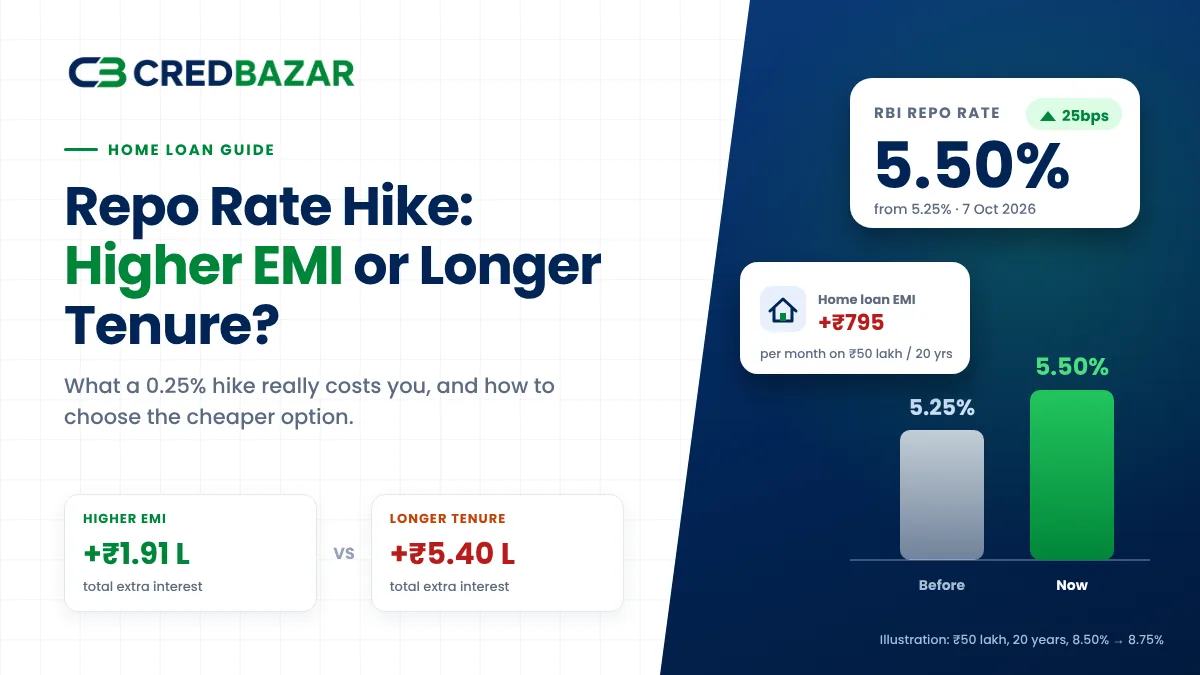
RBI has raised the repo rate to 5.50%. See how the hike affects your home loan or LAP, what a higher EMI or a...
29 Oct 2026
Earning well but still getting rejected? You are not alone. From the "Settled" CIBIL nightmare to negative pin...
09 Oct 2026
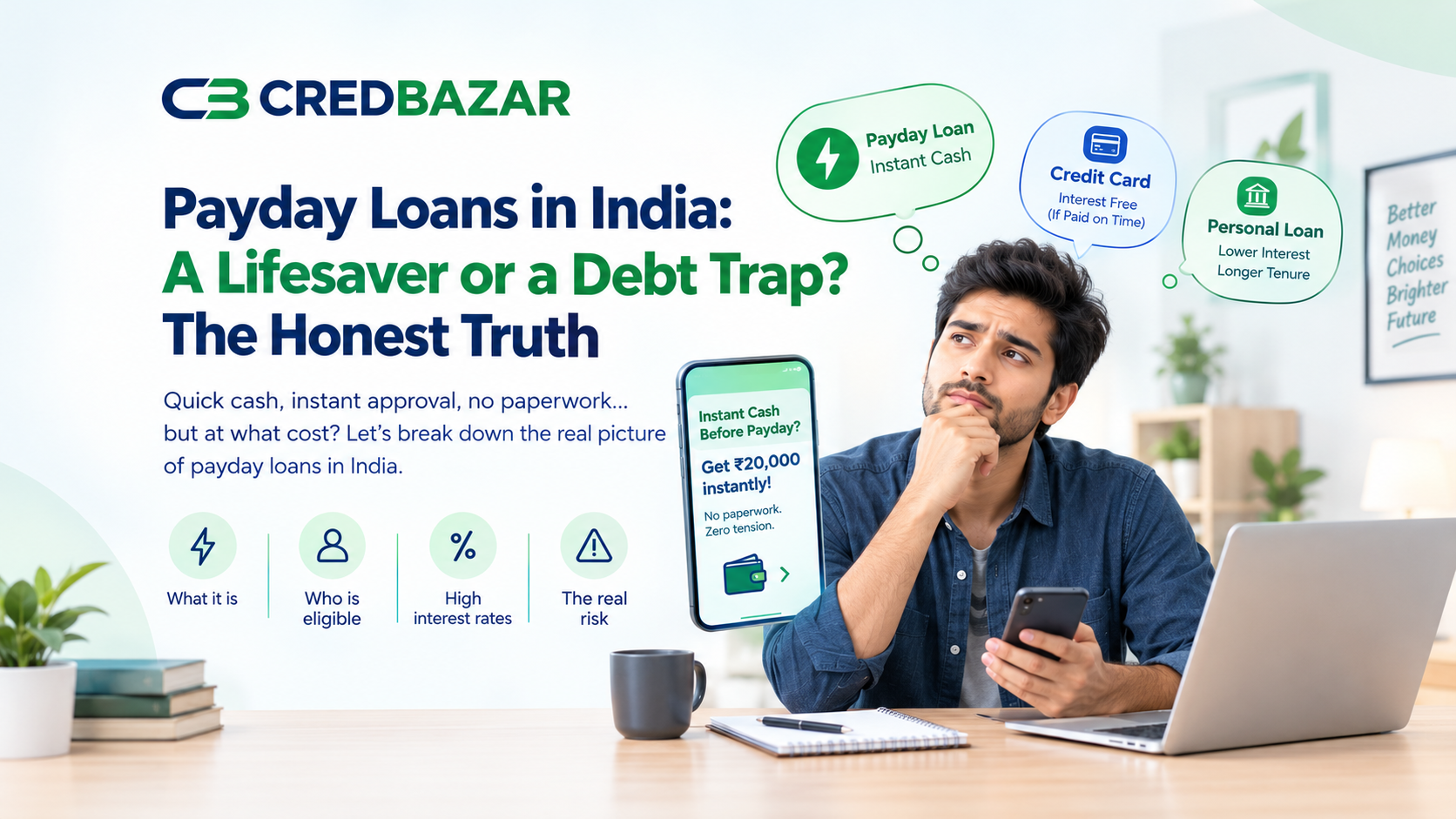
Thinking of taking a payday loan to survive until your next salary? Before you download that instant loan app,...
Fill in the short form on this page with your basic details and loan requirement.
The CredBazar team gets in touch to understand your requirement and explain the next steps.
Share the documents the lender asks for. Approval and final terms are decided by the lender.
About CredBazar. CredBazar helps you connect with lenders for your loan requirement. CredBazar is not the lender: whether your loan is approved, and the interest rate and terms you are offered, are decided by the lender.
The information on this page is general guidance and is not an offer of credit. Loan approval, interest rates, fees, tenure and other terms are decided by the lender and depend on your profile. Please read the lender's terms before you proceed.
Submit a short enquiry and the CredBazar team will get in touch with you.