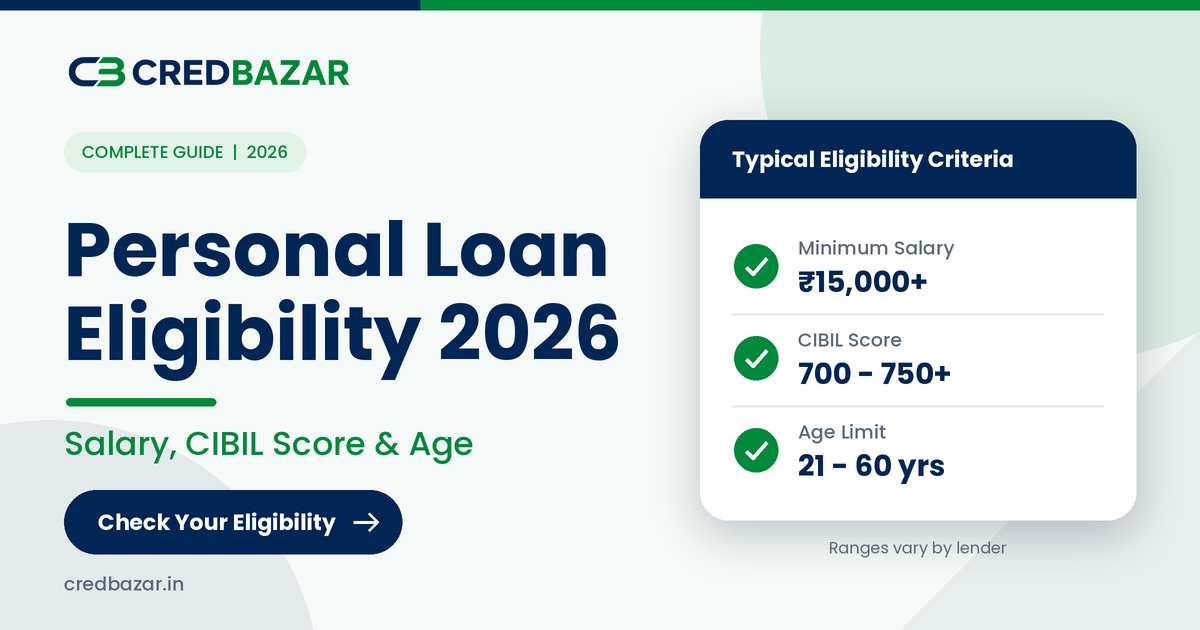
Before you apply for a loan, one question decides almost everything: are you eligible? Personal loan eligibility in India depends on your monthly salary, CIBIL score, age, job stability and existing EMIs. If you don't meet a lender's criteria, your application can be rejected. Each rejection can also leave a hard enquiry on your credit report.
This guide covers the personal loan eligibility criteria most banks and NBFCs use in 2026. It also shows how lenders calculate how much you can borrow, and how to improve your chances.
What Is Personal Loan Eligibility?
Personal loan eligibility is the set of conditions a lender checks before approving your loan. Because a personal loan is unsecured (no collateral), lenders rely on your income, credit history and repayment ability.
Each lender sets its own rules. A large bank will usually be stricter than an NBFC or a digital lender. The ranges below are typical, not fixed.
Personal Loan Eligibility Criteria in India (2026)
| Factor | Typical requirement |
|---|---|
| Age | 21 to 60 years (some lenders allow up to 65 for self-employed applicants) |
| Employment | Salaried or self-employed |
| Minimum monthly salary | About ₹15,000 to ₹30,000, depending on city and lender |
| CIBIL score | 700 to 750+ at banks; 650+ at many NBFCs |
| Work experience | 1 to 2 years total, with 6 to 12 months in the current job |
| Residency | Indian resident with a bank account |
| Existing EMIs | Total EMIs usually capped at 40% to 50% of net income |
Let's look at each factor in detail.
1. Minimum Salary for a Personal Loan
Your income decides whether you qualify and how much you can borrow. Lenders often set a higher minimum salary for a personal loan in metro cities than in smaller towns.
- Metro cities: often ₹25,000 or more per month at banks
- Tier-2 and tier-3 cities: often ₹15,000 to ₹20,000 per month
- NBFCs and digital lenders: some accept lower incomes, usually at higher interest rates
Net (take-home) salary matters more than gross salary, because lenders judge your repayment capacity.
2. CIBIL Score for a Personal Loan
Your CIBIL score for a personal loan is one of the most important checks. It runs from 300 to 900 and shows how reliably you have repaid past credit.
| CIBIL score | What it usually means |
|---|---|
| 750 and above | Strong chance of approval, with better interest rates |
| 700 to 749 | Good, and many lenders will consider you |
| 650 to 699 | Average, and approval is more likely at NBFCs |
| Below 650 | Harder to get approved, and rates can be higher |
A score above 750 improves your chances and can help you negotiate a lower rate. If your score is lower, read our guide on how to improve your CIBIL score before you apply.
3. Age Limit for a Personal Loan
Most lenders set the age limit for a personal loan at 21 to 60 years for salaried applicants. Some allow self-employed borrowers or specific profiles up to 65. The loan usually has to be fully repaid before you reach the lender's maximum age, so older applicants may get shorter tenures.
4. Employment Type and Job Stability
Lenders prefer stable income. They look at:
- Salaried applicants: the company type (government, PSU, MNC or reputed private company), total experience and time in the current job
- Self-employed applicants: business age, usually 2 or more years, along with ITR filings and bank statements
Frequent job changes shortly before applying can weaken your application.
5. FOIR: Your Existing EMIs
FOIR means Fixed Obligation to Income Ratio. It is the share of your monthly income that already goes to EMIs and other fixed payments. Most lenders want total EMIs, including the new one, to stay within about 40% to 50% of your net income.
Example (for illustration only):
- Net monthly salary: ₹50,000
- Maximum total EMIs at 50% FOIR: ₹25,000
- Existing car loan EMI: ₹8,000
- Room for a new EMI: ₹17,000
At about 14% interest over 5 years, an EMI of ₹17,000 supports a loan of roughly ₹7.3 lakh. You can test your own numbers with our EMI calculator.
If your FOIR is already high, consider combining loans first with the debt consolidation calculator.
Personal Loan Eligibility: Salaried vs Self-Employed
| Salaried | Self-employed | |
|---|---|---|
| Income proof | Salary slips, bank statements | ITR, bank statements, business proof |
| Typical age range | 21 to 60 | 25 to 65 |
| Experience | 1 to 2 years total | 2+ years in business |
| Approval view | Easier with a stable employer | Depends on income consistency |
Documents Required for a Personal Loan
Having your paperwork ready speeds up approval.
- Identity and address proof: PAN, Aadhaar, passport or voter ID
- Income proof (salaried): last 3 months' salary slips, Form 16 where needed
- Bank statements: last 6 months
- Self-employed: ITR for the last 2 years, business registration and GST details
- Photograph and a signed application form
Lenders may ask for additional documents, so confirm the list before applying.
Banks vs NBFCs: Which Is Easier for Approval?
Banks usually want a higher CIBIL score, a stable employer and stronger documentation, but they often offer lower rates. NBFCs and digital lenders may accept lower scores or more varied income proof, but they often charge more. Compare offers rather than applying everywhere, because every application can leave a hard enquiry on your credit report.
How to Improve Your Personal Loan Eligibility
- Raise your CIBIL score. Pay all EMIs and card bills on time, and keep credit card use below about 30% of your limit.
- Reduce existing debt. Closing small loans lowers your FOIR and frees up room for a new EMI.
- Check your credit report for errors. Wrong entries can drag your score down, so dispute them with the credit bureau.
- Avoid multiple applications. Applying to many lenders at once can lower your score.
- Choose a realistic amount and tenure. A smaller loan or a longer tenure keeps the EMI within your FOIR.
- Add a co-applicant. A co-applicant with steady income can strengthen your application with some lenders.
- Stay in your job. Apply after you have settled into your current employer.
Salary Overdraft: An Alternative to Consider
If you only need money for a short period, a salary overdraft can work out cheaper than a personal loan. You pay interest only on the amount you use, and only for the days you use it. You can also read our comparison of flexi overdraft vs a personal loan.
Frequently Asked Questions
What is the minimum salary for a personal loan in India?
It varies by lender and city. Many banks ask for around ₹25,000 per month in metro cities, while some NBFCs and digital lenders accept ₹15,000 or less.
What CIBIL score is needed for a personal loan?
Most banks prefer 700 to 750 or above. Some NBFCs approve scores around 650, usually at higher interest rates.
What is the age limit for a personal loan?
Usually 21 to 60 years for salaried applicants. Some lenders allow up to 65 for self-employed borrowers.
Can I get a personal loan with a low CIBIL score?
It is possible with some NBFCs, but you may get a smaller amount or a higher rate. Improving your score first usually gives better terms.
How much personal loan can I get on my salary?
It depends on your net income, existing EMIs, FOIR limit and tenure. Use an EMI calculator to estimate the loan amount your income supports.
Does checking my CIBIL score reduce it?
No. Checking your own score is a soft enquiry and does not affect it. Applying for loans creates hard enquiries.
Can self-employed people get a personal loan?
Yes. Lenders usually ask for ITR, bank statements and proof that the business is running steadily.
Check Your Eligibility With CredBazar
Rules differ from lender to lender, so the quickest way to know where you stand is to compare options. Explore personal loans on CredBazar, or request a call back from our team.
Disclaimer: CredBazar helps you explore loan options and submit enquiries. Loan approval, interest rates and terms are decided by the lenders. The figures in this article are indicative and may change.