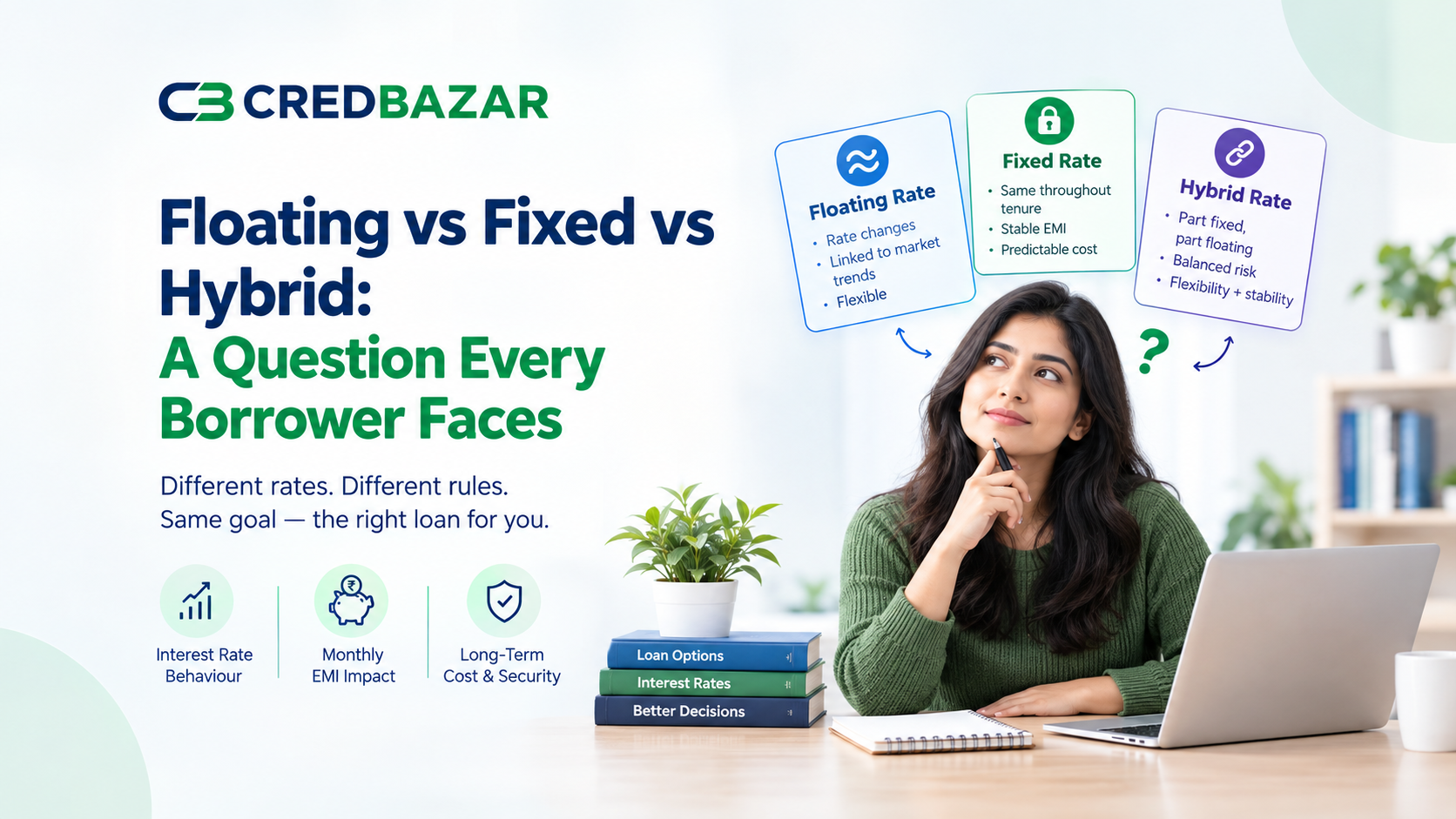
Last month, a borrower named Priya called me. She had a ₹50 Lakh home loan sanctioned. The bank offered her three options: floating, fixed, or hybrid.
She asked me one simple question: "Which one is best?"
I told her there is no "best." There is only what suits her situation. And the difference between the three options could be ₹9 Lakhs or more over the loan tenure.
Let me explain why this choice matters so much.
The Three Options, Explained Simply
Floating Rate
Your interest rate changes based on the RBI repo rate. If the repo rate goes up, your EMI or tenure goes up. If it goes down, you benefit.
Fixed Rate
Your interest rate stays the same for a set period or the full tenure. Your EMI does not change. It protects you from rate hikes.
Hybrid Rate
Your rate is fixed for an initial period (usually 2 to 5 years), then shifts to floating. It gives you early certainty and later flexibility.
Why Most Borrowers Get Confused
The lower number looks better: Floating rates usually start lower than fixed rates. Banks offer floating home loans starting from around 7% for eligible borrowers .
The "peace of mind" pitch: Fixed rates sound safer. But they come at a premium.
The hybrid middle path: It sounds like the best of both worlds. But it comes with its own trade-offs.
Let me compare all three on the factors that matter.
How They Compare
1. Interest Rate
Floating: Usually the lowest starting rate. Most major banks offer floating home loans between 8.30% and 9.65% depending on your profile .
Fixed: Typically 0.5% to 2% higher than floating rates . SBI's fixed rates can go up to 10.50%–11.25%, while HDFC's fixed rates range from 10.75%–11.50% .
Hybrid: Usually priced close to floating, sometimes with a small premium. Kotak Mahindra Bank's hybrid loan is priced comparably with its floating-rate home loans, with no separate premium .
2. EMI Predictability
Floating: Your EMI can change when the repo rate changes. Lenders may also extend your tenure instead of increasing the EMI .
Fixed: Your EMI stays the same during the fixed period. Predictable.
Hybrid: Your EMI stays the same during the fixed period (usually 2–5 years), then becomes floating .
3. Prepayment Rules
Floating: RBI has banned prepayment penalties on floating-rate home loans taken by individuals for personal purposes, effective January 1, 2026 .
Fixed: Many fixed-rate loans charge 2% to 4% of the outstanding amount for early closure .
Hybrid: During the fixed period, prepayment rules for fixed loans apply. After switching to floating, the no-penalty rule applies .
4. CIBIL Impact
Neither rate type directly changes your CIBIL score. What matters is whether you pay on time. A higher EMI can strain your monthly budget and make timely payment harder. A lower EMI leaves more room, which supports a healthy repayment record.
5. Switching Costs
Floating: You can switch to fixed or another lender, but there may be conversion fees.
Fixed: Some lenders allow switching to floating after a lock-in, but they charge 0.5% to 4% of the outstanding principal plus 18% GST .
Hybrid: Exiting the hybrid structure early is costly. Same 0.5% to 4% switching fee applies .
The Math That Matters
Take a ₹50 Lakh loan over 25 years.
At a floating rate of 7.1%:
EMI = approximately ₹35,600
Total interest = roughly ₹57 Lakh
At a fixed rate of 8%:
EMI = approximately ₹38,600
Total interest = roughly ₹66 Lakh
The Difference: Nearly ₹9 Lakhs over the loan tenure .
The fixed rate gives you predictability. But it costs you ₹9 Lakhs more.
Now let's look at the hybrid example.
Kotak's hybrid loan illustration uses a ₹1 crore loan over 25 years at 7.60% starting rate with a 65-month fixed period.
If the repo rate rises by 125 basis points (to 6.50%) during the fixed period:
Floating EMI rises to ₹82,450 by month 65.
Hybrid EMI stays at ₹74,550 during the fixed period.
Monthly difference: ₹7,900.
But here's the catch: If rates fall or stay flat, you get no benefit. You paid the same EMI while floating borrowers paid less .
A Real-World Scenario
Priya chose the hybrid option. Her reasoning was simple.
She was buying her first home. Her budget was tight for the first three years. She wanted EMI certainty while she settled in.
The hybrid loan gave her that. After 39 months, she planned to reassess. If rates had fallen, she would switch to floating. If rates had risen, she would have saved money during the fixed period.
What I told her: The hybrid loan works if the premium over floating is minimal. If the bank charges you significantly more for the hybrid, the math may not work in your favour.
[HUMAN TOUCH: INSERT YOUR OWN OBSERVATION OR CREDBAZAR DATA ON HYBRID LOAN ADOPTION]
Who Should Choose What
Floating Rate is better when:
Your loan tenure is long (15–25 years).
You have a steady income and can handle EMI changes.
You plan to prepay or transfer the loan.
You expect rates to stay stable or fall.
Fixed Rate may work when:
Your loan tenure is short (5–7 years).
Your monthly budget is tight and predictability matters.
You have uneven income (self-employed, business owners).
You want protection from near-term rate hikes.
Hybrid Rate is worth considering when:
The premium over floating is small (less than 0.25%).
You want certainty in the early years when your loan balance is highest.
You are comfortable taking rate risk later.
You have a moderate credit score and the floating rate offered to you is not the best.
What RBI's New Framework Changes
The RBI has proposed a unified framework for loan interest rates, effective from April 1. Both fixed and floating rate loans will have to be linked to an internal or external benchmark plus a spread .
For hybrid products, the confusion is now cleared. Fixed-rate provisions apply during the fixed period, and floating-rate provisions apply during the floating period .
For floating-rate loans, the benchmark reset frequency is now three months. This means rate changes reach you faster, both cuts and hikes .
The spread cannot be arbitrarily increased by lenders for floating-rate loans . This protects you from hidden margin hikes.
My Honest Take
For most borrowers with long tenures and stable incomes, a repo-linked floating loan remains the cheaper option. It starts lower and tends to work out cheaper over time when rates are stable .
A fixed rate makes sense only if you can secure it at or near the bottom of the rate cycle. Locking into a high fixed rate today may lead to long-term overpayment .
A hybrid loan is a middle path. It works if the premium is minimal and you value early certainty. But it is not automatically better than floating .
Need Help Deciding?
If you're stuck between floating, fixed, and hybrid offers, we can help you compare. We work with 30+ banks and NBFCs.
You can check your pre-approved offers and calculate your EMI on CredBazar.in.