New car loan
To buy a new car from a dealer, based on the dealer's invoice or quotation.

Last updated:
Understand how vehicle finance works, why down payment matters, and submit an enquiry to discuss your requirement.
Enquire about Vehicle Loan
Thanks for sharing your details. Our team will review your requirement and connect with you shortly.
A vehicle loan finances the purchase of a car, two-wheeler or commercial vehicle. The vehicle itself is the security: it is hypothecated to the lender, and the lender's name is recorded on the vehicle's registration certificate (RC) until the loan is repaid.
The lender finances part of the vehicle's price and you pay the rest as a down payment. The interest rate, tenure, charges and the share of the price the lender will fund are decided by the lender, and often differ between new and used vehicles.
A lender wants to see that you can pay the EMI comfortably alongside your existing commitments. Criteria differ by lender; commonly reviewed factors are:
Most lenders ask for proof of identity, address and income, plus the vehicle details. The exact list varies by lender and by whether the vehicle is new or used.
Vehicle loans have fewer checks than a home loan, because the lender relies on your profile and the vehicle. The usual sequence is:
Get a quotation for a new vehicle, or the RC and price details for a used one. The loan amount is linked to this price.
You share your income details and documents, and the lender verifies your identity in person or through digital KYC.
The lender checks your credit report and repayment capacity. For a used vehicle, it may also inspect and value the vehicle.
If approved, you receive the amount, rate, tenure and charges with a Key Fact Statement (KFS) showing the APR. Compare it with other offers, including the dealer's.
You sign the loan agreement. The lender's hypothecation is recorded on the vehicle's RC at registration or transfer.
The lender pays the dealer or seller directly, you pay your down payment, and your EMIs start as per the agreement.
Banks and NBFCs regulated by the RBI must give you a Key Fact Statement, including the annual percentage rate (APR) and repayment schedule, before you sign a retail or MSME term loan agreement. Source: RBI circular on Key Facts Statement, 15 April 2024.
Enter the amount you plan to borrow, the interest rate from your offer and a tenure to see the monthly EMI and total interest.
Example only, not an offer
Reducing-balance calculation. It excludes fees and charges. Open the full EMI calculator
With a vehicle loan, you own and use the vehicle, but it is hypothecated to the lender as security. The lender's interest is noted on the registration certificate, so the vehicle cannot be sold or transferred freely until the loan is closed.
After you repay the loan in full, collect the No Objection Certificate (NOC) and loan closure letter from the lender. Then apply to the RTO, usually with Form 35 signed by you and the lender, to remove the hypothecation from the RC, and ask your insurer to update the policy.
Until this is done, the RC still shows the lender's name, which can delay selling the vehicle or transferring ownership.
Lenders offer vehicle finance for different kinds of vehicles and buyers. What is available, and on what terms, depends on the lender.
To buy a new car from a dealer, based on the dealer's invoice or quotation.
To buy a pre-owned car from a dealer or individual, after the lender values and checks the vehicle.
To buy a motorcycle or scooter. Amounts are smaller and tenures are usually shorter.
To buy a truck, bus, taxi or other vehicle for business use, assessed on your income and business.
Some lenders offer specific products or terms for electric cars and two-wheelers. Check what the lender actually offers.
Dealer finance, bank loans and NBFC loans can all look similar. When you compare:
Estimate your EMI and total interest with the EMI calculator
The interest rate is only part of the cost. Charges differ by lender, so check each of these in writing:
Charged for evaluating and processing your application.
For the agreement and for recording the lender on the RC.
What you pay to close the loan early, if the lender is allowed to charge.
Penalties if an EMI is missed or paid late.
For inspecting a used vehicle, where applicable.
Any add-ons bundled with the loan, such as insurance. Ask whether they are optional before you agree.
Many vehicle loans are on a fixed rate. If your loan is on a floating rate, is for a non-business purpose and was sanctioned on or after 1 January 2026, regulated lenders cannot charge for prepayment. Source: RBI (Pre-payment Charges on Loans) Directions, 2 July 2025.
| Vehicle loan | Personal loan | |
|---|---|---|
| Security | The vehicle, hypothecated to the lender | Usually none |
| Use of funds | Only to buy the vehicle | Any legitimate personal need |
| Ownership record | Lender noted on the RC until the loan is closed | Vehicle bought outright, with no lender on the RC |
| Down payment | Usually required | Not linked to the vehicle; you borrow the amount you need |
| Pricing | Set by the lender; secured by the vehicle | Set by the lender; based mainly on your credit profile |
Swipe the table sideways to see both options.
Rates and charges differ by lender and by your profile, so compare actual offers rather than product types alone.
Lenders do not always share the exact reason. Common ones include:
Before you reapply, check your credit report and correct any errors, pay down existing dues where you can, and consider a larger down payment or a less expensive vehicle to bring the EMI within your repayment capacity.
Protect yourself when you finance a vehicle:
Borrow only from RBI-regulated banks and NBFCs. If you are unsure about a lender, check that it is a bank or an NBFC registered with the RBI.
Check that the lender's name on the sanction letter and agreement matches the lender you applied to, including when you apply through an app or an agent.
Never pay an upfront fee to "get a loan approved". Genuine fees are disclosed in writing by the lender.
Do not share OTPs, PINs, passwords or card details with anyone who calls or messages you about a loan.
Read the loan agreement fully before you sign, and keep a copy of every document you sign.
After closing the loan, get the hypothecation removed from the RC and update your insurance policy.
Yes. Many banks and NBFCs finance used cars and two-wheelers. The lender values and checks the vehicle, and the tenure and pricing often differ from a new vehicle loan depending on the vehicle's age.
It depends on the lender, the vehicle and your profile, because lenders finance only part of the vehicle's price. A larger down payment reduces the amount you borrow, your EMI and the total interest.
Usually KYC documents, income proof such as salary slips or income tax returns, bank statements, and the vehicle details: the dealer's quotation for a new vehicle, or the RC and insurance for a used one.
Hypothecation means the vehicle is security for the loan while you keep and use it. The lender's name is recorded on the registration certificate until the loan is repaid.
Collect the No Objection Certificate and loan closure letter from the lender, then apply to the RTO, usually with Form 35 signed by you and the lender, to remove the hypothecation from the RC. Ask your insurer to update the policy as well.
A flat rate charges interest on the original loan amount for the whole tenure. A reducing-balance rate charges interest only on the outstanding balance, so the same rate costs less. Compare offers using the APR in the Key Fact Statement.
Not necessarily. Dealer-arranged finance comes from a bank or NBFC, so compare its APR, fees and any bundled products with offers you get directly from lenders.
Lenders generally allow foreclosure, but the charges depend on the lender and whether your loan is on a fixed or floating rate. Check the foreclosure terms in your sanction letter and agreement.
Yes. Lenders offer commercial vehicle loans for trucks, buses, taxis and other business vehicles. They assess your income or business, and may ask about your experience and permits.
Common reasons include a low credit score, a high existing EMI burden, income that could not be verified, or a used vehicle that did not meet the lender's policy. Check your credit report and consider a larger down payment before reapplying.
29 Oct 2026
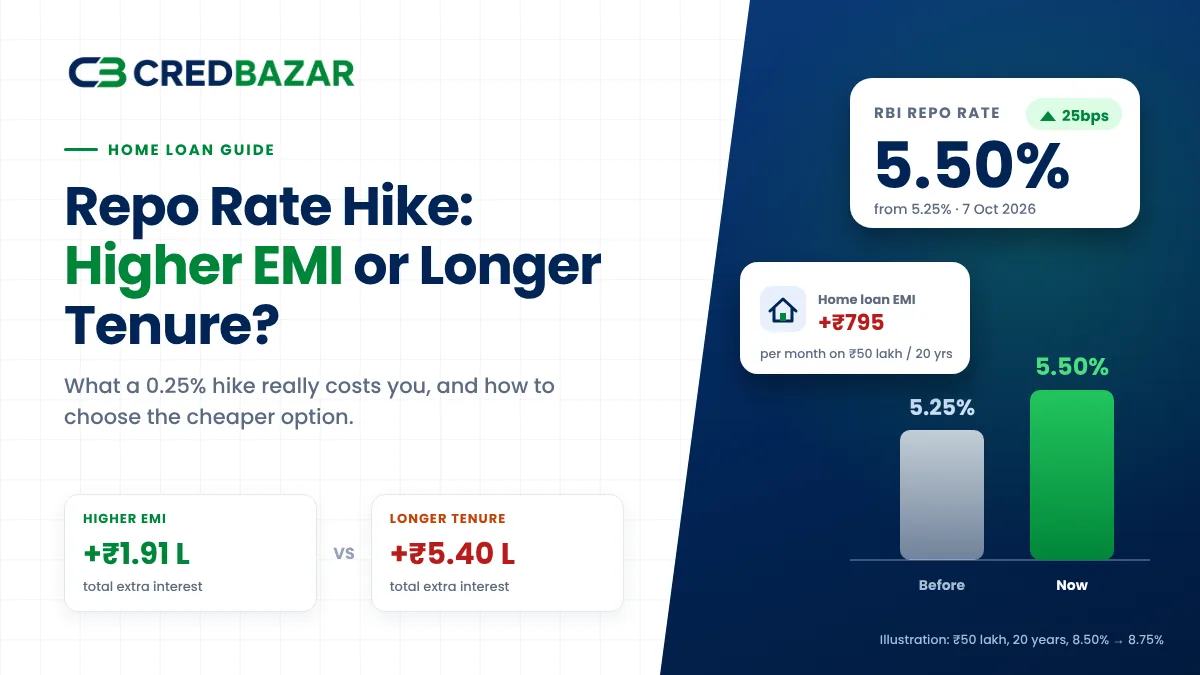
RBI has raised the repo rate to 5.50%. See how the hike affects your home loan or LAP, what a higher EMI or a...
29 Oct 2026
Earning well but still getting rejected? You are not alone. From the "Settled" CIBIL nightmare to negative pin...
09 Oct 2026
Thinking of taking a payday loan to survive until your next salary? Before you download that instant loan app,...
Fill in the short form on this page with your basic details and loan requirement.
The CredBazar team gets in touch to understand your requirement and explain the next steps.
Share the documents the lender asks for. Approval and final terms are decided by the lender.
About CredBazar. CredBazar helps you connect with lenders for your loan requirement. CredBazar is not the lender: whether your loan is approved, and the interest rate and terms you are offered, are decided by the lender.
The information on this page is general guidance and is not an offer of credit. Loan approval, interest rates, fees, tenure and other terms are decided by the lender and depend on your profile. Please read the lender's terms before you proceed.
Submit a short enquiry and the CredBazar team will get in touch with you.