Last Tuesday, a borrower named Ravi called me. He had two loan offers in hand.
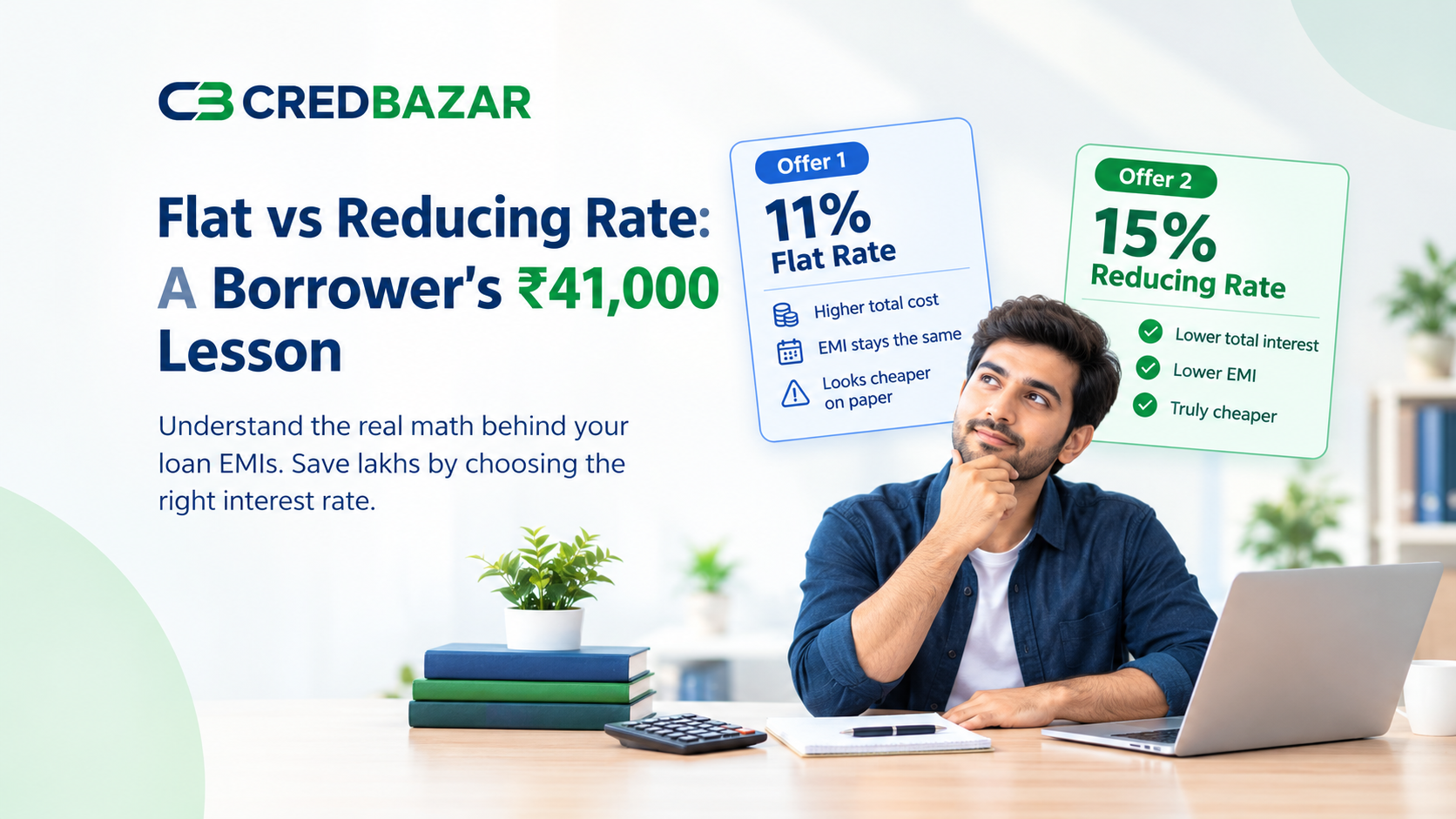
One said 11% flat. The other said 15% reducing. He was ready to sign the 11% offer because the number looked smaller.
I asked him to wait. We ran the numbers. The 15% reducing loan was cheaper by almost ₹41,000 over three years.
This isn't a one-off. I've seen this happen many times. The flat rate looks friendlier, but it hides the real cost.
(This happened to me as well. When I started working, I managed to save some money, and like everyone else, I wanted to buy my favourite bike. The interest rate offered by the lender was tempting, but at that time, I wasn’t aware of the difference between flat and reducing interest rates. By the time I understood how it worked, I had already paid a huge amount in interest to the lender.)
Why This Confusion Happens
The lower number looks better: A flat rate looks smaller on paper. An agent might say "Sir, it's only 11%!" But the real cost can be higher.
The real cost adds up: On a ₹5 Lakh loan, choosing flat over reducing can mean paying tens of thousands extra.
The math is locked in after signing: Once you sign the loan agreement, the calculation method is fixed.
Your monthly budget matters: Knowing your real EMI helps you plan your expenses.
The Two Ways Lenders Calculate Interest
1. Flat Rate
Interest is calculated on the full loan amount for the entire tenure. Even if you repay half the loan, you pay interest on the original amount.
2. Reducing Rate
Interest is calculated on the remaining loan balance. As you repay, your interest burden goes down.
How it affects your EMI: With a flat rate, your EMI stays fixed, but the interest component is high throughout. With a reducing rate, your EMI is usually lower than a flat rate loan of the same quoted percentage.
How it affects your credit score: A flat rate by itself does not directly change your CIBIL score. But higher EMIs can make it harder to pay on time. Missing payments or high credit utilisation (above 30% of your limit) can pull your score down. Lower EMIs leave more room in your budget, which supports a healthy repayment record.
Prepayment rules: RBI has directed that prepayment penalties cannot be levied on floating-rate loans taken by individuals for non-business purposes, sanctioned or renewed on or after January 1, 2026. This does not automatically apply to fixed-rate loans or older loans. Check if your specific loan qualifies.
Watch out for processing fees: Fees vary widely. Always check the Key Fact Statement (KFS) and the sanction letter for the exact amount. RBI requires these charges to be disclosed upfront.
The Math Ravi Saw
Loan Amount: ₹5 Lakhs. Tenure: 3 years (36 months).
Offer 1: 11% Flat Rate
Interest = ₹5,00,000 × 11% × 3 = ₹1,65,000.
Total Repayment = ₹6,65,000.
Monthly EMI = ₹18,472.
Offer 2: 15% Reducing Rate
Interest is calculated on the reducing balance.
Total Interest = ~₹1,23,976.
Total Repayment = ~₹6,23,976.
Monthly EMI = ~₹17,333.
The Difference: Ravi would have paid about ₹41,124 extra with the 11% flat rate.
The 15% reducing loan was cheaper despite the higher quoted rate.
What to ask: Ask for the Effective Annual Rate (EAR) or the reducing rate equivalent for your specific tenure.
A Real-World Scenario: Medical Emergency
Hospital bills need quick money. A local NBFC might offer a flat rate loan.
Let's assume the reducing rate offered is also 15%. On a ₹2 Lakh loan for 2 years, the 15% flat rate costs ₹60,000 in interest. The 15% reducing rate costs roughly ₹32,736. The flat rate looks smaller on paper but ends up costing more.
Many hospitals tie up with fintech apps. Check the reducing rate before accepting.
The Bottom Line
A Flat Rate may work when:
The loan amount is very small (under ₹20,000).
The tenure is short (3–6 months).
You have no other option and the total interest is affordable.
A Reducing Rate is better when:
The loan amount is larger (₹50,000+).
You need 1–5 years to repay.
You want to minimise total interest and maintain a healthy repayment record.
For long-term loans, a flat rate can significantly increase your total cost.
Need Help Deciding?
If you're stuck between two offers and want a second pair of eyes, we're here to help. We compare loans from 30+ banks and NBFCs.
You can check your pre-approved offers and calculate your EMI on CredBazar.in.